Reliable Ground Improvement for
Stronger Foundations
Ground Improvement Solutions
We offer complete Ground Improvement Solutions to increase the strength, stability, and overall performance of weak or difficult soil conditions. Our expertise includes proven techniques such as geogrid reinforcement, geocell confinement, prefabricated vertical drains (PVDs), stone columns, and subgrade improvement systems. These solutions help increase bearing capacity, minimize settlement, control ground deformation, and provide stable foundations for roads, railways, embankments, landfills, and industrial developments.
We deliver full turnkey services – from geotechnical investigations and engineering design to material supply and site installation – ensuring dependable, economical, and long-term results. Through precise engineering and high-quality geosynthetic systems, we help enable sustainable infrastructure development on challenging ground conditions.
We undertake complete turnkey execution—from geotechnical assessment and design to material supply and on-site installation—ensuring reliable, cost-effective, and long-lasting outcomes. With engineered precision and superior geosynthetic systems, we support sustainable infrastructure development on challenging ground conditions.
Benefits of Ground Improvement

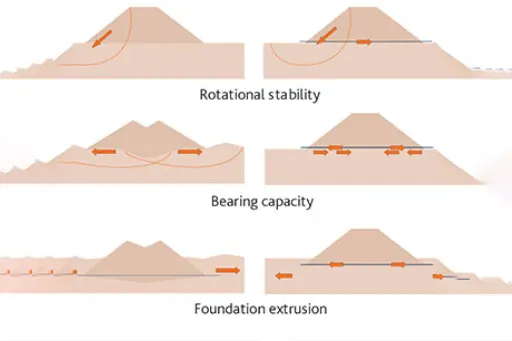
Enables Construction of Higher Embankments
Improves Soil Load-Bearing Capacity
Increases Foundation Stiffness Efficiently
Can Be Installed in All Weather Conditions
Lightweight and Simple to Install
More Economical Than Soil Replacement

Does Not Require Skilled Labour
Minimizes Ground Surface Deformation

Reduces Risks of Long-Term Settlement
ATGRID-Biaxial (PET)
We deliver advanced ground improvement solutions using ATGRID-Biaxial (PET), a high-performance reinforcement product developed for effective soil stabilization. Manufactured from high molecular weight polyester yarns exceeding 25,000 gm/mol, ATGRID provides outstanding tensile strength and long-term durability under demanding site conditions. Its carefully knitted structure offers uniform strength in both machine and cross-machine directions, ensuring efficient load transfer and improved subgrade performance.
Our engineering team incorporates ATGRID into projects through complete design assistance, technical analysis, and site execution to improve embankments, foundations, and working platforms. Featuring a durable polymeric coating and strong interaction with surrounding soil, ATGRID-Biaxial (PET) enhances bearing capacity, reduces deformation, and delivers long-term structural stability.
Features of ATGrid-Biaxial (PET)

Uniform Aperture Structure for Consistent Load Transfer

UV-Resistant Polymeric Surface Protection Coating
High LTDS of 100 kN/m with Minimal Creep
ATWEB (Geocell)
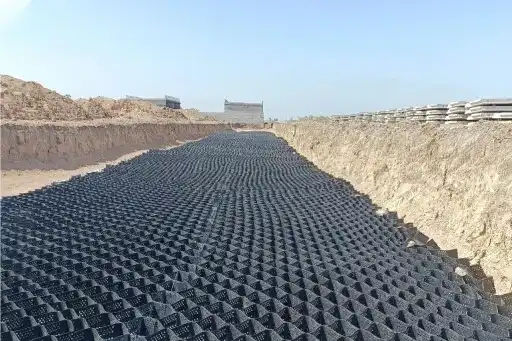
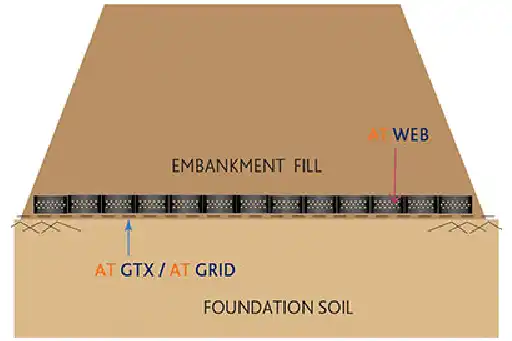
We provide specialized ground improvement solutions using ATWEB Geocells, an advanced cellular confinement system developed to strengthen weak and unstable ground conditions. Manufactured from ultrasonically welded high-density polyethylene strips, ATWEB creates a strong honeycomb-shaped structure that significantly improves bearing capacity when expanded and filled with locally available soil or aggregates. The cell depth and weld spacing can be customized according to project requirements, ensuring effective performance under different site conditions.
Our engineering team offers complete support – from design and technical evaluation to site installation – ensuring long-term stability for embankments, working platforms, load transfer platforms, and foundation systems. ATWEB helps reduce settlement, distribute loads evenly, and provide a durable and cost-effective solution for ground improvement applications.
Features of ATWEB

Effectively Reduces Ground Settlement

Can Be Easily Cut Without Damage
Strengthens Weak Soil Layers
Prefabricated Vertical Drains (PVDs)
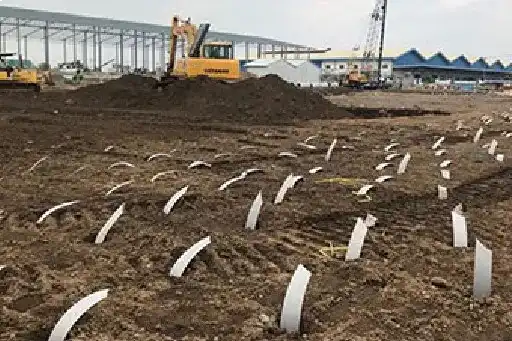
We provide specialized ground improvement solutions using Prefabricated Vertical Drains (PVDs), an effective drainage system developed to accelerate the consolidation of soft and compressible soils. Manufactured with a durable plastic core wrapped in a high-permeability geotextile filter, PVDs create vertical drainage paths that allow excess pore water pressure to dissipate quickly under surcharge loading. The spacing and installation pattern are carefully designed to suit specific project requirements, ensuring efficient performance across varying ground conditions.
Our engineering team offers complete support – from design and geotechnical analysis to supply and on-site installation – ensuring improved ground performance for embankments, highways, railways, storage yards, and foundation systems. PVDs effectively reduce consolidation time, control post-construction settlement, and provide a reliable and economical ground improvement solution.
Features of PVDs

Drainage Core Relieves Excess Pore Pressure
Significantly Speeds Up Soil Consolidation

Economical Solution for Settlement Control

Enhances Soil Shear Strength

Improves Ground Load-Bearing Capacity

Supports Faster Project Completion

Stone Columns
We provide dependable ground improvement solutions using Stone Columns, a widely accepted method for strengthening weak and compressible soils. Stone columns are vertical granular elements installed to improve soil shear strength, increase bearing capacity, and considerably reduce settlement caused by structural loads. Our engineering team conducts detailed geotechnical evaluations to determine the appropriate column spacing, diameter, depth, and installation technique, ensuring effective performance for every project. Using vibro-replacement and dry or wet top-feed methods, we construct high-quality stone columns that enhance drainage, accelerate soil consolidation, and promote uniform load distribution.
A&T Engineering handles the entire process – from design and technical analysis to construction and field supervision – delivering a durable and economical solution for embankments, foundations, industrial platforms, and transportation infrastructure projects.
Benefits of Stone Columns

Improves Soil Shear Strength

Reduces Overall Ground Movement

Lowers the Risk of Liquefaction

Minimizes Variations in Natural Soil
Effectively Controls Total Settlement
Enhances Soil Drainage and Consolidation